
The Chinese Mentality
and a peaceful acceptance of the authority

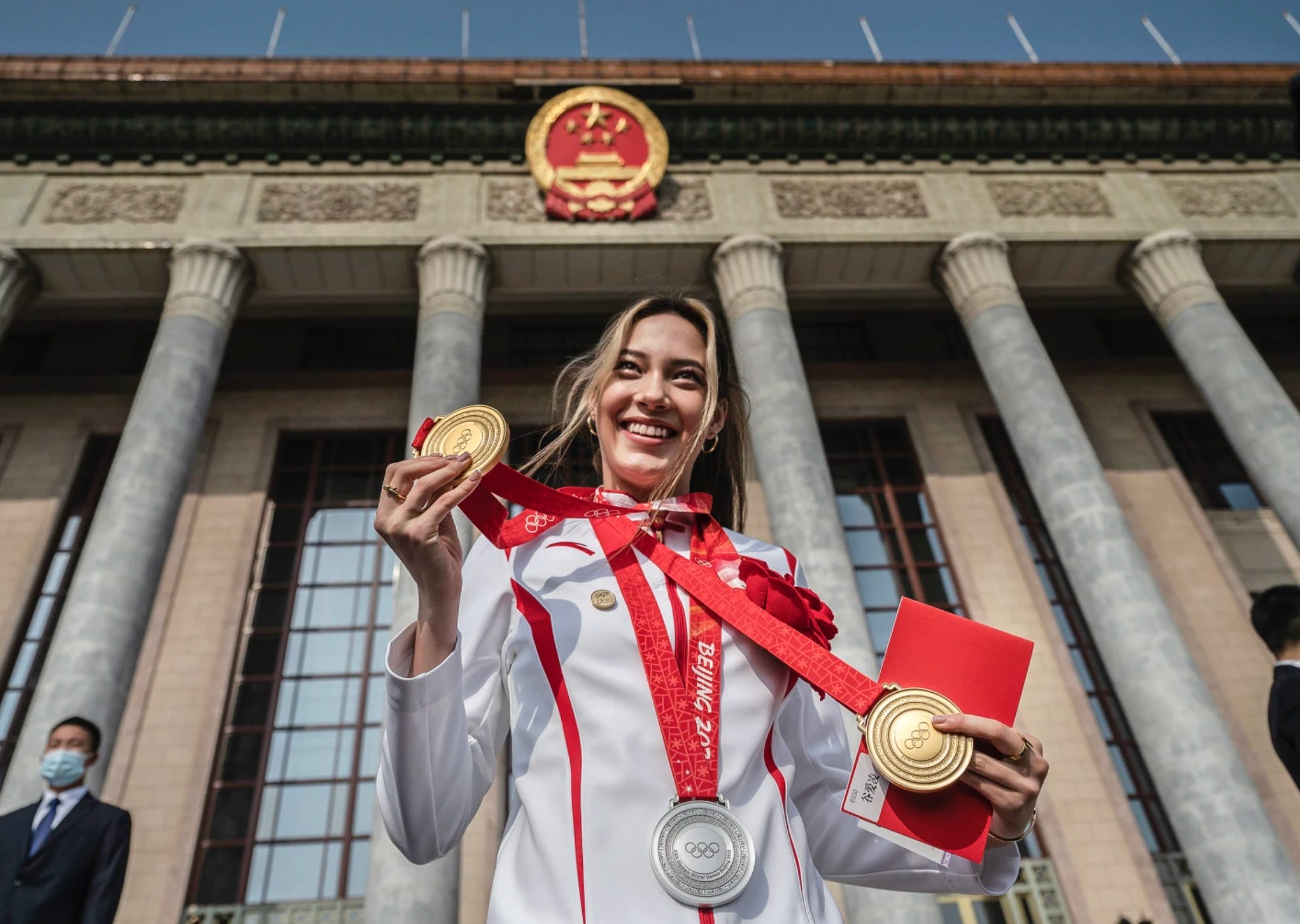
I asked my aunt, “China does not recognize dual citizenship. Yet how can Gu Ailing1 represent China in the Olympics without renouncing US citizenship?”
I have this deep fear that suddenly, I’ll not be able to go home—to China. It’s irrational, but also sort of rational.
During the three years of COVID, China closed its borders to all foreigners. I carry a US passport. In the midst of it, my grandpa passed away in the hospital. I never got to say goodbye. The fact that I feel 50% Chinese and call Beijing home, but cannot have a Chinese passport, and that I have to choose between being a Chinese or an American, leaves a deep scar on my psyche.
“Of course,” my aunt responded as a matter of fact, “for the extremely talented, the government will make an exception. 那是人家,不是我们普通人。That’s for exceptional people — not ordinary folks like us.”
Ordinary folks like us… My American ass wanted to fight back. Somehow, I was uncomfortable with the idea that we can just accept being normal. Why can’t we fight to become that exception?
In America, under the umbrella of optimist individualism, we’re trained to believe we can all be the next Steve Jobs. As Alain de Botton said:
“It’s probably as unlikely that you would nowadays become as rich and famous as Bill Gates, as it was unlikely in the 17th century that you would accede to the ranks of the French aristocracy. But the point is, it doesn’t feel that way. It’s made to feel, by magazines and other media outlets, that if you’ve got energy, a few bright ideas about technology, a garage — you, too, could start a major thing.” —A kinder, gentler philosophy of success | Alain de Botton
The other emotion underneath this discomfort is unfairness. If dual citizenship is unacceptable, it should be unacceptable to all. But my aunt seems to be wholly comfortable with the “unfairness”.
Under the Chinese psyche lies an inherent acceptance of status and hierarchy.
My aunt, like other Chinese, does not just accept, but is at peace.
True acceptance means the anger from unfairness and inequality is not a lived concern. And I think that’s the core idea of why this is so uncomfortable to an American.
Not all men are created equal.
The extraordinary 人家2 can break rules. Us the ordinary will not, and we’re happy anyway.
Upward mobility is not just difficult, it’s not always sought after either.
The ordinary have a very nice life. We work as 牛马 (wage slaves) doing the 996, and yet, we are content. Maybe we still have access to all these consumer products (if you ever visit China, you’d love being a consumer). Maybe close ties with the family make one feel full. Maybe the busyness with children’s education and the 内卷 (involution) keep the mind occupied.
It’s this kind of unique Chinese optimism.
In the Chinese psyche, there is an inherent assignment of a place in society.
To take it a step further, this acceptance of place extends to a trust in the institution and a willingness to be governed. The government knows better. The government has a plan.
Whereas for Americans, we trust no one but the self. Not the government, not one with more policy experience. Only our own felt experience and our own reality. And this felt experience must have a say in impacting the larger system. This felt experience must be heard. In the US, there is no expectation and little trust for the government, and we’re used to taking things into our own hands.
The American government’s attitude is very much aligned with what the people want. Kennedy said in his inaugural speech in 1961, “Ask not what your country can do for you, ask what you can do for your country.”
In China, we expect the government to perform for us. We do not just expect it, we trust it, and we let it. The government, the authority, has a different status. Specific people will know more and know better than me.
In Chinese, there is a phrase known as 政府监督 “Government oversight." This phrase is imbued with responsibility, a state-led authority to ensure a level of well-being. It reads more like a parent overseeing a child's homework. It’s not surveillance or control, it’s care. Whereas in English, this phrase becomes "The government is watching," negative undertone all around.
Having government oversight is absolutely a positive sentiment for the Chinese. And not just for the Chinese: A German friend who’s visiting China related, “China is a country built on anxiety. There are more security cameras than people in Shenzhen. Somehow I feel so safe.”
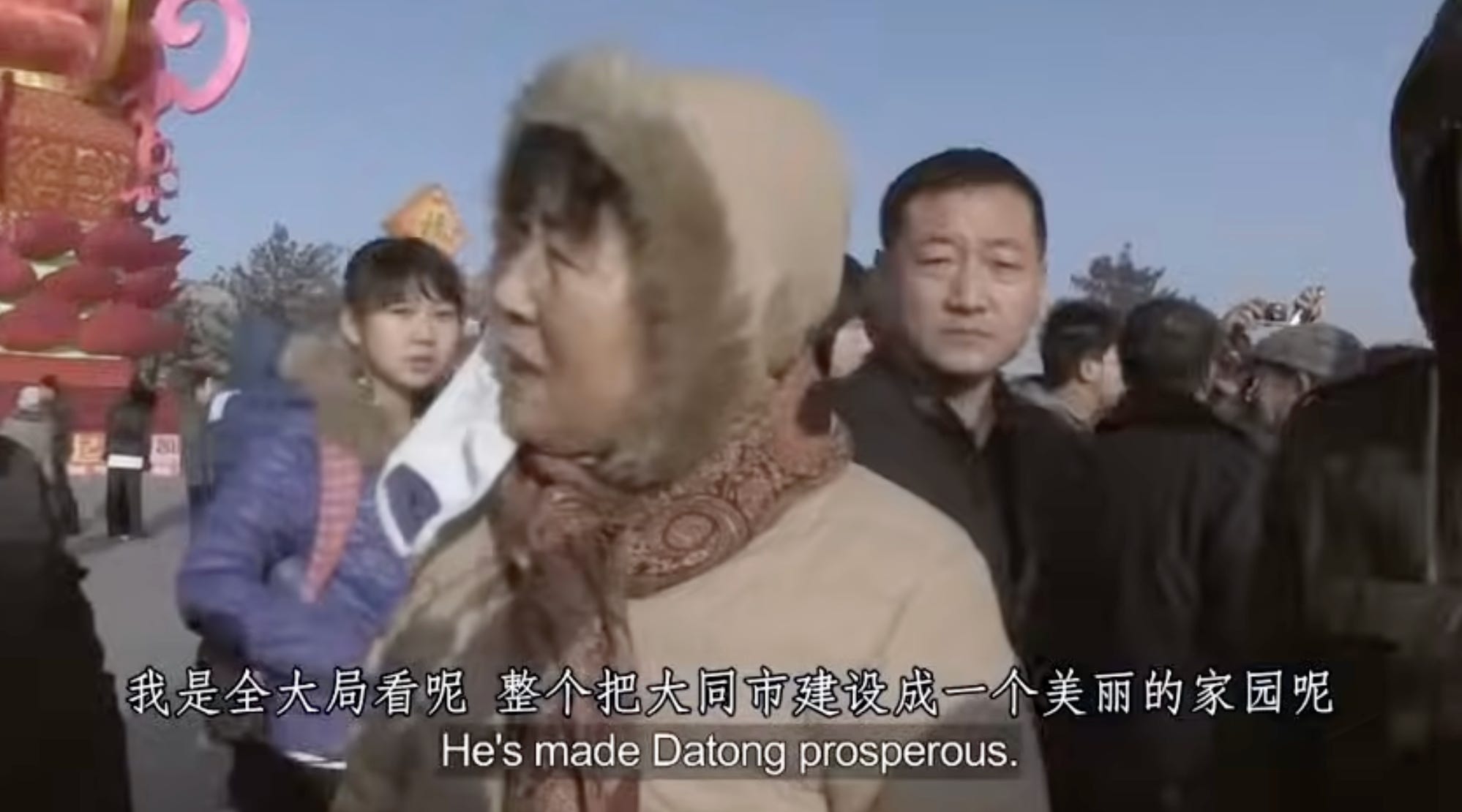
In the documentary The Chinese Mayor, the mayor forced massive relocation in order to build the new city of Datong 大同. Yes there was a lot of ugliness around relocation, a lot of beating and orders against the individual will. But amongst the outcries, some help me understand what it feels like to be Chinese:
“他是为了整个大同不是个人。He did it for all of Datong, not for himself.”
“拆了我的房我说他有计划。He demolished my house — but I say he had a plan.”
“下一代绝对就是感谢。The next generation will absolutely be grateful.”
—
Once I described my dreams and goals with my work—how I optimize for learning and impact, for both process and the end goal. My cousin remarked to her boyfriend:
“你看看人家受美国教育的就是不一样。See, someone with an American education really is different.”
The subtext is, this education is great, but we probably won’t be able to get that kind of education in our lifetime. The sub-subtext is, even though we didn’t have that kind of education ourselves, we can give our children that kind of education.
The last thing I’ll say is, it all sounds like the Chinese relinquish control, accept the status quo, and do not have the agency we describe in the English language. Yet, what I’ve noticed is that even though the self accepts its place, one redirects this hunger for exceptionalism in the next generation. The agency is not endowed upon the self, but in their children. Whereas, in American individualism, we live in the present generation.
It’s like how an American pays for their own college loans and their own mortgage. Each generation mends itself. While in China, each generation takes care of the next generation, saving for children’s college and paying for their first home.
There is that similar unfair hope for the children to rise above the ranks (望子成龙,望女成凤 hope for sons and daughters to become dragons and phoenixes). I am ordinary, but my child will be extraordinary. This paradigm drives the over-investment in education, high pressure in having children because of the cost of a multitude of extracurriculars.
With my cousin, there’s no envy. There’s aspiration through me and projected forward onto her future children. When the mayor demolished the homes, the residents knew it was a necessary sacrifice for their children and a future in the making.
This passive acceptance, perhaps, is an active choice. It is the force that propels us to fight hard, while standing at peace in the face of hardship and inequality.
—
Thanks for reading and hello from Shenzhen! These days, I’m spending more time in China and thinking of doing an experiment: organizing a business tour to China for friends from around the world. If interested, please fill this out :)
Thank you to friends from Essay Club and Write of Passage for the feedback: Cam Houser, Matthew Beebe, and Michael Dean.
Gu Ailing (谷爱凌) aka Eileen Gu, is the first freestyle skier to win three medals at a single Winter Olympics and is currently competing at the 2026 Milan Olympics. She was born and raised in San Francisco, and in 2019 made the controversial decision to compete for China rather than the US. Despite representing China, she never publicly confirmed renouncing her US citizenship. Read more here.
I must pause to share more context on this term “人家 (ren-jia)”, meaning “other people”, but it carries the cultural weight that “the other is better.” It is used when Chinese parents tell their children to look at how ren-jia “other children” excel, or how the Chinese refer to foreigners’ stronger education. It’s a kind of admiration for the other while feeling a sense of shame in oneself. But this shame is not the self-degrading kind, more a matter-of-fact acknowledgment of hierarchy.
I find the article pretty amusing because I think it is the other way around.
Americans have the highest level of trust in and expectations for institutions. Chinese have the lowest.
In collective cultures, large groups dominate the power landscape, and these large groups usually control the large institutions, like legal, police, etc. We call it corruption here but in China the manipulation of institutions by large groups is just a way of life.
Business in China cannot rely on legal contracts to enforce partnerships or trade agreements because the legal institution can be manipulated by large groups.
That’s why the culture of doing business in China is to get each other super drunk, it’s both a vibe check and a way to loosen your tongue and see who you really are.
If you get into a partnership and the other person steals your business, in the US you can sue for damages and you will generally be rewarded. In China you will be laughed at, because likely your partner has protection from larger groups and can’t be touched.
In China there is no trust in institutional power. There is however a strong trust in those who wields the power. This is Confucianism, where filial piety as a moral value (duty to one’s parents) extends from subject to ruler as well.
So yes Chinese generally trust their ruling party, but not institutions.
But it is also more complicated than that. There is a reason why rich Chinese people want to take their money out of China - become too rich and all of a sudden you are a threat to the ruling party. And there is no legal protection, the ruling party can actually use the legal system to get you. That’s what happened to Jack Ma. He was too naive and didn’t realize that his individual protections and right to his money was afforded by western protections which do not exist in China.
Americans hate the government because they believe (subconsciously with moral conviction) that protection of individuality is the governments responsibility and infringement upon individuality is immoral and wrong. It’s why forcing masks during covid has such a backlash, it was viewed as an infringement of individual freedoms.
China has a rich weave of Confucian, Daoism, and Buddhism. Acceptance is a very daoist outlook,and acceptance of authority is a very Confucian outlook. They are quite different. But yes accepting how things are is a major theme of Chinese culture. A lot of “why fight to be in power when the people in power fight to feed you”? Also a lot of “play your role in society to be happy” (as opposed to America’s climb the ladder to be happy).
Play your role is by no means easy though. If you are a woman, you better be married and popping out kids by 25! If you are a grandma, you need to be nagging at the next generation while cutting fruit for them! And if you are a kid, study! Dont choose anything for yourself, let your parents choose for you!
Your article reminded me of a conversation I had with someone living in China.
I asked him, how is it that you can work 6 days a week from 10am-10pm and not feel a need to complain?
I simply couldn’t comprehend… and yet here in my not-so-distant part of the world in Singapore people are starting to talk about boundaries and feeling unhappy about overtime work.
He talked about acceptance and that this is just the way of life.
But the interesting thing I took away from the convo is that acceptance is not merely saying “it is what it is”. It is acceptance but with the commitment to still give 100% to work when the occasion calls.
It’s not exactly the same as contentment which sometimes carries a notion that the status quo is acceptable. It’s contentment but mixed with optimism and determination.
The idea of 人家 is similar, as you pointed out. That you can be aware that others have it better but not let it get you down.
I love the nuances in your article and would love to visit you in China one day! ✨