
One of Us
On trusting strangers in Egypt

Osiris, the first divine king of Egypt, brought civilization, agriculture, and order to humanity. His brother Set—god of chaos, desert, storms—murdered him out of jealousy, sealed his body in a chest and threw it in the Nile. Set later found the body, dismembered it into fourteen pieces, and scattered them across Egypt.
His wife Isis—goddess of magic and devotion—along with her sister Nephthys, traveled all over Egypt collecting the pieces. She found all of them except one (his phallus, which a fish had eaten, and the Nile’s fish were considered slightly impure ever after).
With the help of the gods Thoth and Anubis, she reassembled the body, wrapped him in linen, transformed into a bird and temporarily resurrected Osiris…
—
Scene - 01 - The tourist
I spent the last month traveling in Egypt.
Walking along the Nile, a child would appear by my side out of nowhere, holding a few papyrus bookmarks and gesturing for food. I looked into his eyes. The boy had a natural frown between his eyes, the kind of frown that took centuries of training.
Stop engaging in conversation with the people on the streets, Baba would often tell me. They’re not good people. They’re onto tricking or hurting you. He’s probably right. But I want to believe that people are simple; I continue to find the energy to trust.
Another horse-carriage driver appeared by my side. He was the third person that day to tell me about a local ‘Friday festival market’. “Just one dollar. Fifty pounds.” I finally believed him and hopped onto the horse carriage. He was nice. He even let me drive the whip. We crossed over the Avenue of Sphinxes just before Maghrib. A cool breeze blew in the summer heat.
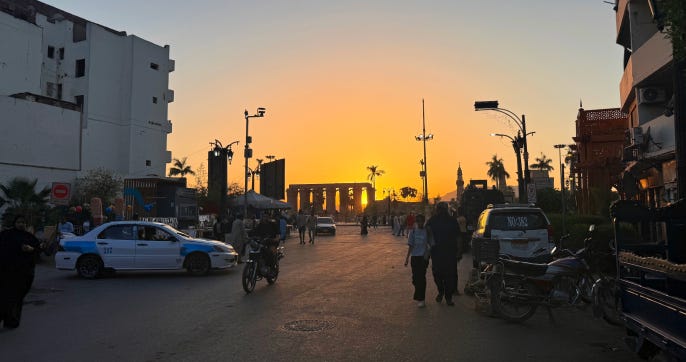
Soon, the carriage stopped in a dark alley…
Well, Egypt is safe. No one will ever rob or put you in any physical danger, but they’d try their absolute best to exercise the technical art of trickery. We came to a dark, American-priced souvenir shop. I asked the driver, where is the outdoor market you spoke about? He then took me to a tourist bazaar not far from where we started. When I was about to hop off the carriage, the driver said, “Four dollar.”
I couldn’t tell if there was a ‘Friday market’ to begin with. I just knew, at that moment, I had lost the curiosity about my surroundings. I grew a shell I didn’t want and stayed within it.
The next time a horse carriage driver approached me, “Karnak? One dollar. Fifty pounds.” I turned and sent him a glare, a glare that made him shudder and retreat.
Why are people not kind? There are places where people struggle more economically, yet the lengths the Egyptians would go to extract. Why?
Perhaps, thousands of years of tourism produced that strong sense of defense against the foreign. The longer a place has been intertwined with tourism, the deeper the scam culture seeps. One observes their brothers, uncles, and cousins behave as such. It’s education. It’s generational. Perhaps, they’re missing a kind of connection to their ancestors. After all, the last priest who read the hieroglyphics left us over 1,600 years ago. When they find their cultural home in Islam, the ancient Egyptian relics are none more than a vehicle for extraction and transaction. They look at the pyramids and temples with a similar pair of foreign eyes as we do, Isis and Osiris just an ancient tale to be told.
—
Scene - 02 - One of us
An Egyptian tour guide named Karam invited me to his home in a village on the outskirts of Luxor. A few days ago, I met Karam on the Nile cruise. He was another stranger I chose to trust.
When I stepped into the car, a little boy of around ten looked at me with the most curious eyes. They were eyes of happiness and simplicity. He must come from love; it was love and abundance. He kept staring with a smile, the kind of uncontrollable excitement of a child. It was contagious.
I stepped into the house. It’s dark; there’s no natural light. It’s made of thick stone walls and small holes above our heads that are windows. Summers in Luxor can get to over 50 degrees Celsius; you probably don’t want the sunlight. In the middle of the house is a stairway that spirals toward the light, leading to the rooftop.
The ground floor is for living and dining. The first floor is for the first son, his wife, and their children. The second is for the second son’s family, and so on. The last floor, still being built—it’s for Karim and his future wife—the oldest son in the next generation of the family. It would be another few years before it’s ready.
“She has a special role,” Karam happily introduced, pointing at Sana, the sister-in-law of his eldest brother. “She’s in charge of all the happenings inside the house. All the children of the house also refer to her as mom. And if they wish to go out, even when she’s sleeping, they must wake her for permission…”
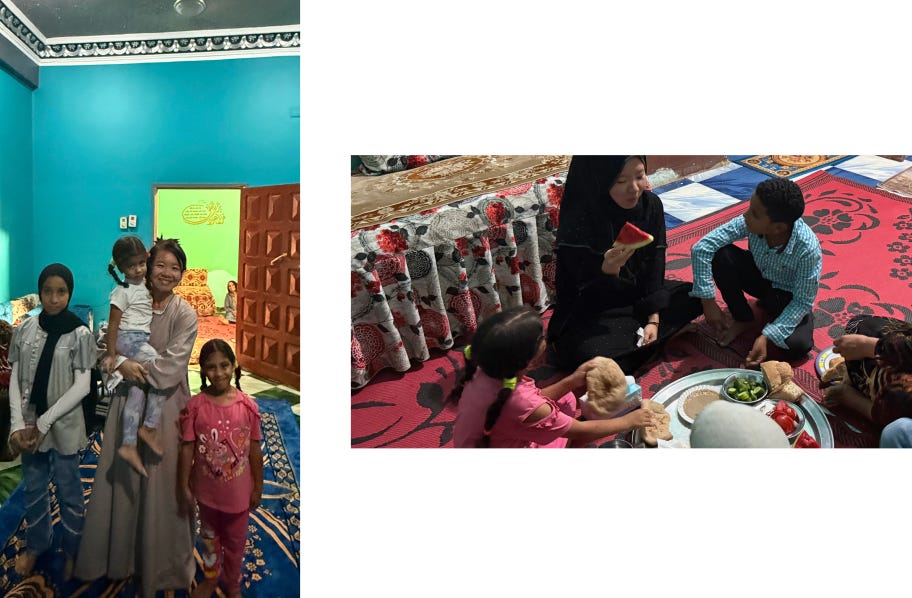
Before he had a chance to finish, the little girls grabbed my hand and led me to their bedroom. They dressed me in a hijab. My hair kept falling out, and they carefully tucked it in again and again. The little girls held my arm to the kitchen, and there we fried potato fries, cut tomatoes, cucumbers, and cheese.
I sat with his family on the floor around a big plate of small dishes of delicacies we had just made. The little boy from the car swiftly broke off a piece of bread to pick up a piece of egg. Sana shook her head and said, “Save some food for Kuku.” He slowed down his movement, but retained that smile. The smallest girl in the house leaned into me, made herself comfortable, and wrapped my arms around her. Karam’s mom and sister sat by the wall, watching us eat, and occasionally smiled. I looked into their eyes, and those eyes simply smiled.
As I was leaving, Sana helped me put on my backpack like a mother.
For the first time in a long time, I felt at home.
—
Later on the car ride back, Karam told me, “You’re without borders. It’s energizing.”
I’m not exactly sure what it meant. Maybe it’s a kind of no boundaries but in a good way. Maybe it’s opening up, extending trust to strangers immediately.
“Do you invite tourists to your home often?”
“Sometimes, but only when they feel like one of us.”
And they’re simple people. What makes a group of people simple, and what makes another complex? Simple means operating with kindness and having no hidden agenda. Simple is inviting a stranger to your home and treating them like family. Simple is not calculating, not protecting, or managing how much to reveal and how quickly to trust. Simple is moving through the world without the walls up. Simple is the way the corners of the eyes curve upward. Simple is looking a stranger in the eyes and wanting them to be happy.
Karam said, “You’re like one of us.”
It’s the biggest compliment one could receive.
—
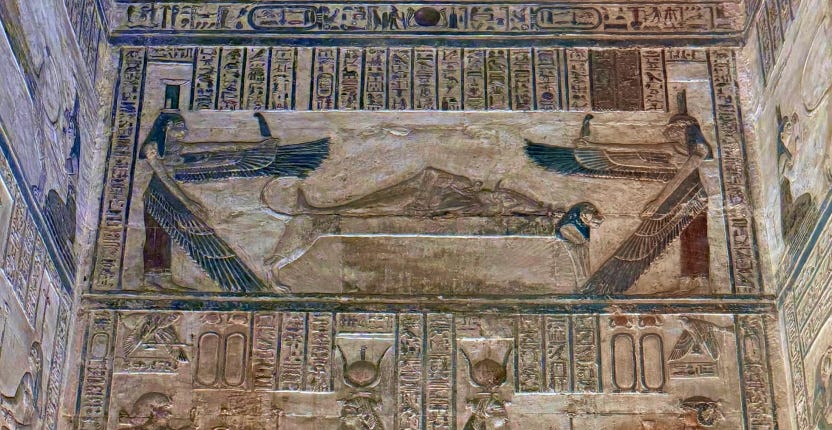
The next day, Karam was our guide to the Temple of Dandara. In one of the best-preserved rooms of the temple, carved in Egyptian blue and red ochre, the colors of the goddess Hathor, was a scene of Isis and Nephthys mummifying Osiris. Karam told me a story.
“In ancient Egyptian culture, when Isis collected all the pieces of her husband Osiris, she and her sister Nephthys stayed by him and spoke to him as if he were alive. Nowadays, in Islam, when a man dies, after the entire family says goodbye, the wife and mom, or the sister and mom, remain. The man is like the sister’s first boyfriend; the mom is the first love. They stay behind to speak to him as if he’s still alive…”
And perhaps, the connection with Isis and Osiris is more than what I had imagined.
Thank you to friends from Write of Passage and Essay Club for the brainstorming and feedback: CansaFis and Charlie Becker.
…the kindness of strangers i have seen throughout the world is unbelieveable…now granted i have also seen some terrible people, but over 99% of my experiences traveling have been filled with proud people sharing…that type of humanity makes me proud to be human…great essay…