
Here is Shenzhen
来了就是深圳人 Once you arrive, you are us.

There are a few cities in the world where most residents are there not because of birth, but because they choose to be.
Shenzhen is such a place.
I like asking locals how they feel about their city. In many other cities, I hear complaints: about economy, about stagnation; other times, attitudes of nonchalance, neutrality, or the passive it is what it is.
But in Shenzhen, in a “self-selected” city, when asked the same question, people’s eyes sparkle. The comments are not just positive; they’re passionate.
–—
Shenzhen is a city of immigrants.
It’s like the US in a way, but more extreme. In Shenzhen, almost everyone is an immigrant in a young city not yet fifty years old. The native Shenzhen-born are often those born after the 2000s (in English, Gen Z; in Chinese, 00后, “post-2000s”). They’re the ones who remember growing up in the neighborhoods of Shekou and Luohu, regions first developed from favorable policies of the SEZ (special economic zone) that attracted businesses and migrants.
Their parents are undoubtedly immigrants. They came to Shenzhen in search of opportunity and settled early enough to give birth to the first generation of Shenzhenese. And these settlers love this place so much that their answer to the sometimes difficult question “Where are you from?” has become Shenzhen.
After all, 来了就是深圳人。Once you arrive, you are a Shenzhener.
Amongst self-selected cities, there is New York. Most people you meet love New York. While the locals have a sense of pride, the settlers have a kind of passion: the passion that a city not only aligns with their industries but with their soul. They share the locals’ pride in cutting bullshit, walking fast, being unapologetically mean but kind at the same time. Breathing the New York air, you feel a kind of can-do energy that makes you feel you stand on top of the world. You own the world.
Another one is San Francisco. It has a similar magnetism. The world comes for tech. There’s rarely a city anywhere with such a strong, purpose-driven scene. You walk into a room, 100% of the people are in tech. At first it’s exciting, but at some point you start to seek the different. You start to look for the life of that sailing teacher who’s lived in North Beach his entire life and knows just about everyone in his 15-minute walk radius. You start to look for that rootedness that this work city somehow doesn’t offer. And just like its long history of the gold rush, once the work is done and money made, people leave.
Shenzhen, it’s more like New York where the people who came don’t have a plan B. They don’t work hard while quietly entertaining the idea of eventually moving away. When you come for the soul, you stay. And while the world moves to New York, all of China moves to Shenzhen.
I met a friend from Jiangxi. She worked and married in Sweden, but nowadays she and her husband are exploring settling in Shenzhen. In Sweden, they uphold the culture of lagom, the idea of having “just enough”, and with it, this ultra ease of life where top of mind is going to a summer house. It’s work-LIFE balance where life outweighs work. So for anyone remotely ambitious, it’s tough. She had a friend in Sweden who won prizes, but when friends visited, she had to put those awards away. In Norway, there’s such a term: Janteloven, where people discourage each other from being great. The Nordics are my absolute favorite region in the world for urban planning and the life between buildings. But I have to say, I haven’t lived there long enough to experience the drain on ambition.
The venturous, they choose Shenzhen.
Shenzhen has two city slogans. One, “Time is money, efficiency is life. 时间就是金钱,效率就是生命。” They lived it to the fullest. There is the notion of Shenzhen Speed: the first university was built in seven months, from breaking ground in February of 1984 to students moving in in September the same year.1 The government stripped away cumbersome bureaucratic procedures common in many inland cities in China 内陆城市; getting simple administrative procedures done no longer required guanxi 关系 and dadian 打点 — relationships plus a little something extra. In addition, there are thousands of programs and subsidies to help entrepreneurs succeed. When OpenClaw first came out, the government passed a policy encouraging people in Longgang to build with it. I don’t know if the government even really understood what it was (well, no one does, really). But it didn’t matter. 做了再说, do it first, talk later is at the core of experimentation.
Like New York, people in Shenzhen walk a little faster. The difference is, for New York, it’s “If you can make it here, you can make it anywhere.” Whereas for Shenzhen, it’s “If you can’t make it here, you can’t make it anywhere.”
The second slogan is “Once you arrive, you are a Shenzhener. Shenzhen doesn’t exclude outsiders. 来了就是深圳人,深圳不排外。” Some cities exclude. An example often cited is Shanghai: if you’re not from Shanghai, you often face being looked down upon, a kind of discrimination people make no effort to be discreet about. Perhaps this 排外 exclusion is not as jarringly felt for foreigners because in China every foreigner is cool, their status very much elevated and welcomed everywhere. But to a Chinese person, you feel it. In Shanghai, you’re defined by the value of the stuff you wear. In Shenzhen, you’re defined by how hard you’re willing to grind. Maybe it’s a learned culture, from Steve Jobs, from Silicon Valley. We don’t know.
Once you arrive, you are us. This kind of slogan doesn’t exist in New York. It doesn’t exist in San Francisco. According to unspoken rules, it takes about ten years to become a New Yorker; the status is earned. But to Shenzhen, just come. 深圳很包容 Shenzhen is deeply inclusive — it’s ingrained in the blood of the city itself, the city’s DNA.
一个城市的基因,或许比我们想象的更重要。城市的基因决定了硅谷的科技,决定了纽约的文化底蕴、金融与服装。而深圳的文化底蕴,给了许多人一个家。从高管到最基层的员工,打工人到科技行业的牛马,给了他们机会,给了他们赚钱的机会,过上更好日子的机会。从高管,到最基层的员工,打工人到科技行业的牛马,深圳给了他们机会,给了他们赚钱的机会,过上更好日子的机会。
A city’s DNA matters. They defined Silicon Valley’s tech, relentless ambition, and curiosity for the next big thing. They gave New York’s cultural depth, the free-spirited creation, the avant-garde, a world capital’s grand allure. While Shenzhen’s culture gave many people a home. From business owners to employees 牛马 to service workers, they left their hometowns and saw opportunity: better opportunity, better clientele, better culture — the opportunity to live a better life. 深圳只适合搞钱 — Shenzhen is only good for getting money. Perhaps so. They came for money, at the same time proud of it.
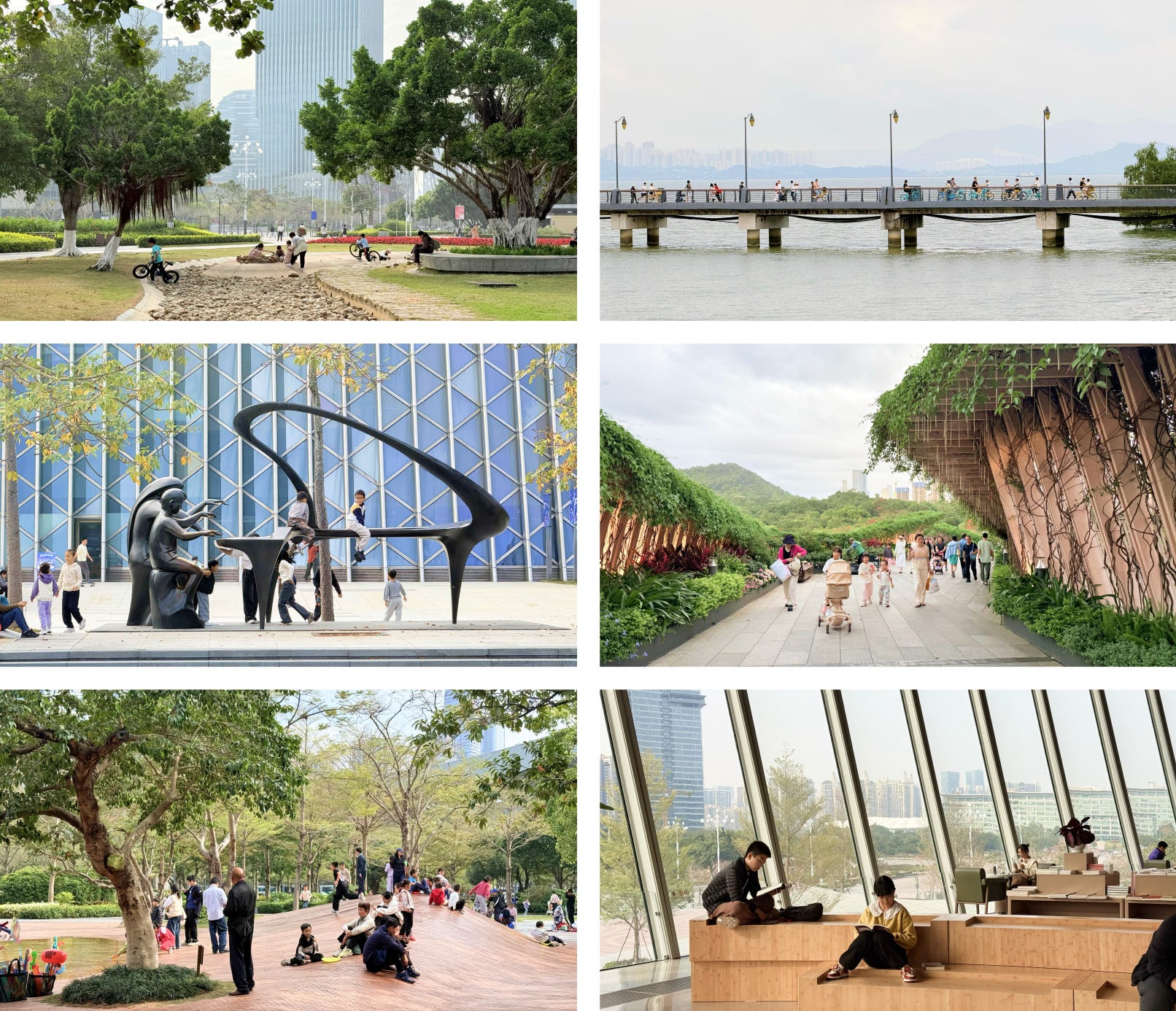
I came to Shenzhen, in part, to study why this new city of 40 years is the most successful new city in the world, which I believe beats its contemporaries by large measures. On physicality alone, instead of wide boulevards, it’s life between buildings, walkable streets, and third spaces.
And I think it’s the city’s DNA — built in from the city’s establishment, the shared values that designers and builders of pop-up cities and Network States speak about — that attract a very specific group of people.
For Shenzhen, that shared value is speed, radical inclusion, and unapologetically making money to build a better life.
深圳是个小美国 Shenzhen is a little America.
深圳是小新加坡 Shenzhen is a little Singapore.
深圳是公平的 Shenzhen is fair.
深圳很包容 Shenzhen is accepting.
深圳是真的好 Shenzhen is truly great.
深圳是大陆最有活力的城市 Shenzhen is the most dynamic city in China.
There are so many phrases about Shenzhen. But the commonality is: every resident has their own good thing to say about the city, from a place of admiration, respect, and gratitude.
And by the way, this city hasn’t reached its maxima 深圳还没有达到上限。 Maxima meaning: reaching an upper bound, the highest potential. New York, London, Tokyo, even Shanghai — they’ve all risen to the highest on the world’s stage. Shenzhen hasn’t, far from it. This new city is a growing organism that hasn’t reached maturity.
If cities are like relationships, then Shenzhen is a chosen life partner one can grow with.
There is a third slogan: “Let some people get rich first. 先让一部分人富起来。” In English, this line reads a little discriminatory, a bit politically incorrect. There is no way you could tell San Francisco that some people should get rich first.
But Shenzhen culture says: if you work hard, you get ahead. If you don’t, 活该被丢下,被落下 you deserve to fall behind, be left behind. And perhaps, those drawn to this city believe that if I work harder than others, I will be 那一部分人 that some people. And I think the unspoken next line after “let some people get rich first” is: if you come, you’ll be that some people.
*Title inspired by E.B. White's Here is New York.
Thank you friends from Essay Club and Write of Passage for the feedback and edits: Rik van den Berge, Cam Houser, Lance Mason, and Stephen Morrison.
…sounds like a good place and a good time to be…
This came out great, Coco!! Thank you for sharing. This piece really made me feel like I visited Shenzhen and got to feel what its like.