
China, where strength lies in scale
Ecosystem thinking at its finest

Somehow, spending time in China, I hear this voice: “你不是一个人,你有国,有家 You’re not alone, you have your family, and you have your country.”
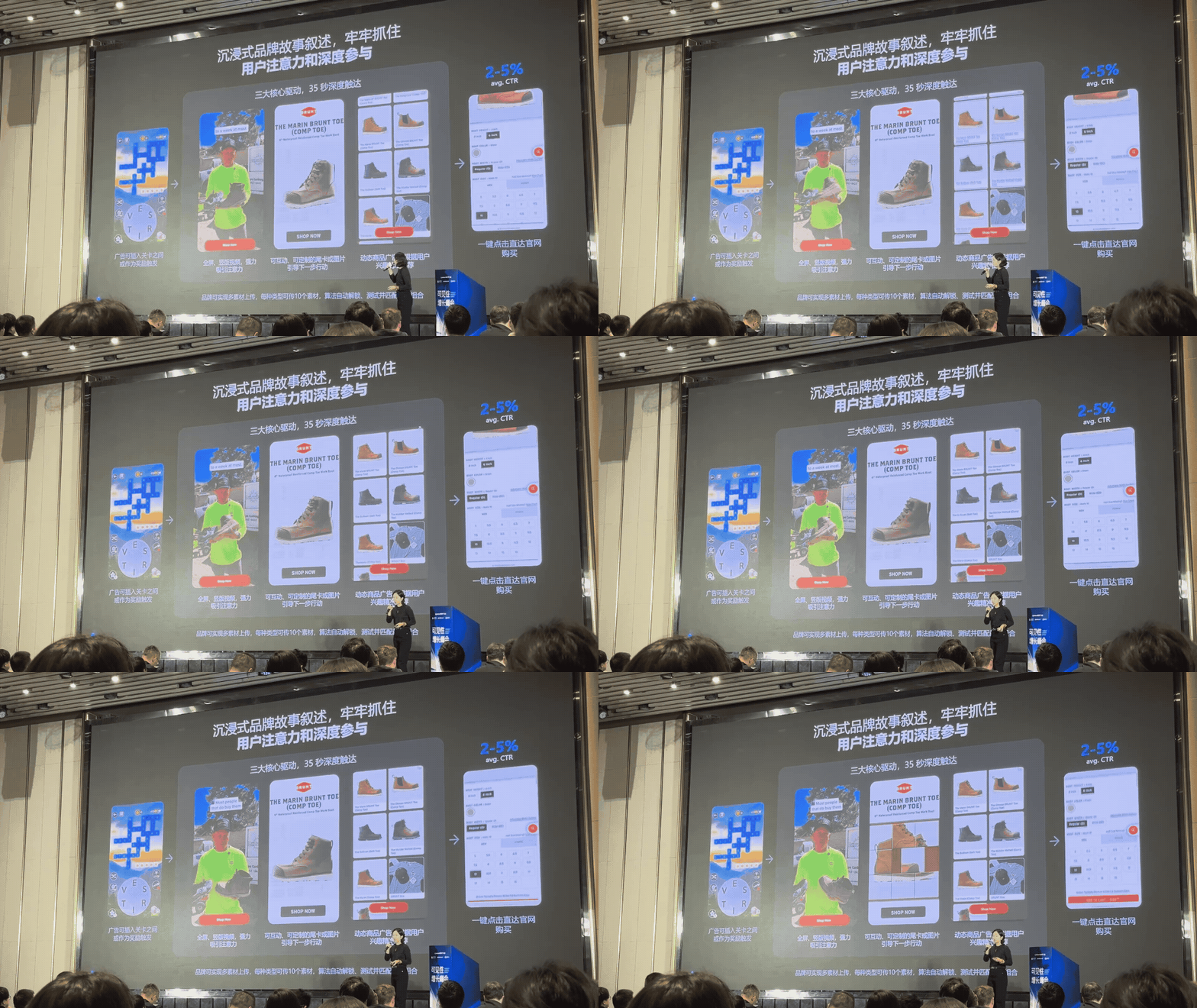
Recently, I went to a mini one-day conference in Shenzhen that brought together 1,000 people to learn how to market to Americans — dissecting consumer behavioral patterns on Instagram and ChatGPT, platforms the Chinese cannot access behind the Firewall.1
It reminded me of the SAT. Many years ago, I came back to China to take SAT preparation courses. At the time, I didn’t question why I came to China when resources existed in the US. Somehow, the Chinese consistently scored higher. I remember the grammar teacher breaking down every sentence structure and predicting every possible syntactical scenario. One trick I still remember: “Whenever you spot the word ‘being’, immediately select that choice — it is almost always grammatically wrong according to the rules of the SAT. While everyone else is still reading the question, you’re already onto the next one!”
Pattern extraction and knowledge sharing in China are collective projects, not ones that rely on individual discovery. A collective of brains distils complexity into a few straightforward guidelines and tricks, setting everyone up for success.
China thinks in ecosystems.
The region 珠三角, Greater Bay Area (GBA), encompasses the economic activities of nine cities including Guangzhou, Shenzhen, Foshan, and Dongguan. Together, they form a manufacturing ecosystem spanning entire supply chains of industries such as furniture and robotics. All robotic component suppliers can be found within 100 kilometers, enabling hardware innovation to move at software speed. Geographical proximity allowed Shenzhen to brand itself as the epicenter of Physical AI.
Maybe this scale has to do with sheer population. The GBA has approximately 86 million people, vs the San Francisco Bay Area’s 7-8 million. For every group of 20 Americans attending conferences and sharing industry knowledge, there are roughly 230 Chinese building and sharing playbooks on the same topic.
Mao once said, “人多力量大 More people, more power.” But it’s not simply more people. It’s the ability to build infrastructure, institutions, and systems that transform a massive population into a network of production and consumption.
The government serves as that holistic force tying everything together — the bird’s-eye view that envisions every step and puts structure and players in place. Creating a manufacturing ecosystem starts with imagining the full lifecycle of a product: from the ten steps before production, to the cross-border e-commerce infrastructure and trade fair ecosystem that sells overseas. The government then orchestrates resources to support each link. For example, to fund innovation, local governments pump money into startups the way Venture Capitals do, subsidizing spending to capture the market. Except for Venture Capitals, LPs (Limited Partners, aka a small group of private investors) benefit. In China, the “LP” is the public. When a government-backed startup succeeds, the return is tax revenue, urban development, and a better city.
But when each part of the chain has its own place in the bigger picture, each part almost doesn’t need visibility into how the rest works. Instead of trying to figure out every step, people are more comfortable sitting in that narrow lane of comfort, being told the 4 steps to execute, and doing those 4 steps extremely well. With the SAT tricks, one can get a perfect score without actual reading proficiency. The factory manufacturing the Micro Linear Servo Actuator does not need to know how a humanoid robot is sold overseas. Specialization is common worldwide, but in China, it’s hyperspecialization. A side-effect: one outsources thinking the bigger picture to the “higher” entity, the government or the boss.
For America, it’s grit. For China, it’s resilience. The grit to figure things out with relatively little support. The resilience and discipline to do the repetitive and find genuine joy in it.
I had a conversation with a barber. As he worked the scissors in a carefree manner, he said, “I identify with 小人物思维 ‘small people thinking’. 把自己的事情做好,活得开心就好 Do your own part well and be happy.” I saw from the mirror a genuine contentment that I envied a little. You don’t have to hold the whole picture, and there’s a strange relief.
When I had to figure out college apps, SEO, and build a startup in the States, I felt alone. There are related communities (i.e. founders communities, marketing-focused panels and meetups), but not the hand-held methodologies, not the offline communities of thousands, not this powerful form of collective insight to lean on.
Growing up in the States, we’re far from small people thinking. The instinct is to hold all ten steps on our own; to take ownership, ask questions, know the why behind the 4 steps, find meaning in ambition. Perhaps, this feeling of being alone is less the availability of resources, it’s this internal pressure to figure things out on my own otherwise it’s not my work.
One time, I went to an interpersonal relationship workshop in Guangzhou. In a mock demo, a woman stands on one side, facing her partner on the other side. The moderator asked two additional volunteers to stand behind the partner to represent his parents, then four more volunteers to stand behind the parents to represent the grandparents, and then another eight to hold space for the generation before. And so, in a relationship, you’re not facing one individual, but the force of the entire family and 族群 tribe. At the same time, you have an entire tribe to reach out to for support.
Somehow, spending time in China, I hear this voice: “你不是一个人,你有国,有家 You’re not alone, you have your family, and you have your country.”
Thank you friends from Write of Passage and Essay Club for the edits and feedback: Cam Houser, CansaFis Foote, and Leanna.
The firewall, it seems, is selective and goal-aligned, not absolute (enforcement is discretionary perhaps like most policies in the world). It helps with national stability via censorship. Export, aka the “going out” strategy (走出去) is a national mandate that encompasses cross-border e-commerce as a priority sector. Hence, the VPNs that enable it align with the national mandate.
…your essays make me want to visit and learn so much more about China…this one especially made me very reflective towards my perception of community and individuality…scale in any artform looks more impressive all the time…
The SAT “being” trick as a window into how collective pattern extraction works in China is such a good opener. Not reading proficiency, just distilled pattern, and it works. The barber with genuine contentment in 小人物思維 is my favorite though, “You don’t have to hold the whole picture, and there’s a strange relief” — that’s the whole dichotomy between the two systems in one sentence. Really loved this one Coco 💙